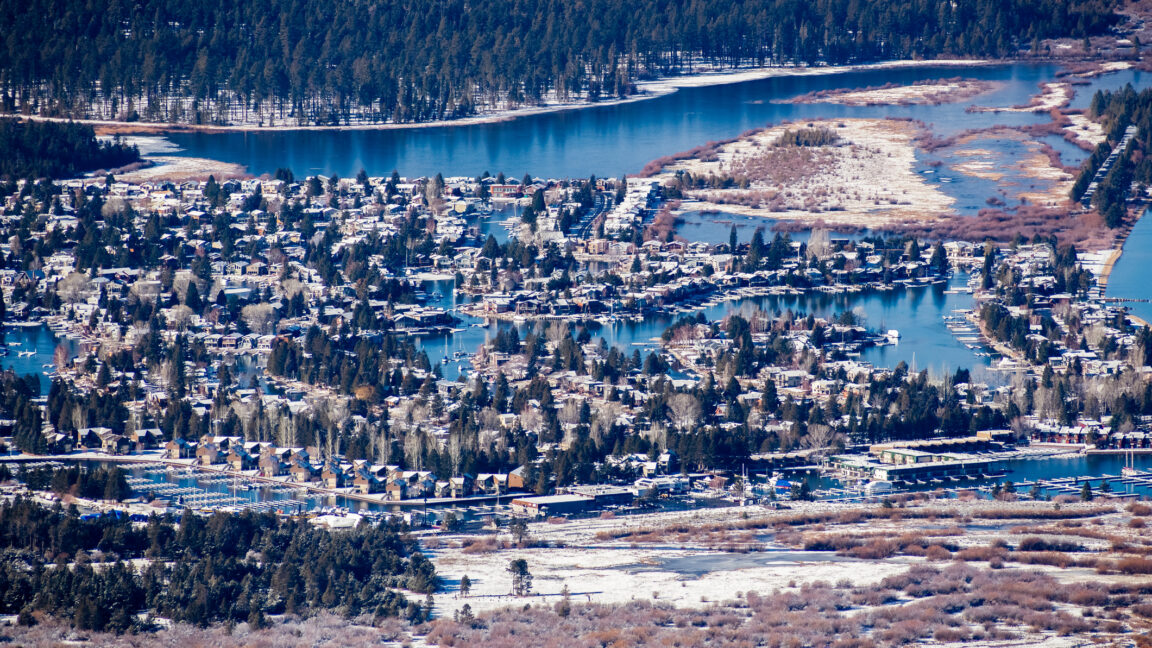
Lake Tahoe residents lose energy supplier to data center boom
Town’s 49,000 California residents compete with Nevada data centers for energy.
Lake Tahoe residents lose energy supplier to data center boom - Ars Technica
Skip to content
Text settings
Story text
Size
Small Standard Large
Width *
Standard Wide
Links
Standard Orange
* Subscribers only Learn more
Minimize to nav
The tourist and ski resort town of Lake Tahoe must scramble to find a new energy supplier by May 2027—a situation that stems in part from a Nevada utility company devoting more power capacity to new data centers. The energy crisis impacts 49,000 California residents who live near Lake Tahoe, nestled in the Sierra Nevada mountains on the border between California and Nevada. Lake Tahoe’s local electricity provider, California-based Liberty Utilities, has been obtaining 75 percent of its power from the Nevada-based company NV Energy. Their latest agreement covering the Lake Tahoe region could see NV Energy pull out by May 2027, according to extensive reporting by Fortune. However, an NV Energy spokesperson has told Ars that “there is no scenario where Liberty customers will be left without service as a result of this transition.” Nevada’s fast-growing data center development was one of the main reasons given by NV Energy for ending its energy supply agreement with Liberty, according to a Liberty filing with California regulators. Fortune highlighted data from NV Energy’s own planning documents showing that a dozen data center projects in northern Nevada could drive 5,900 megawatts of new demand by 2033. Such data center demand has also spurred NV Energy to sign contracts with tech companies to secure additional power-generation sources. Amazon recently agreed to support the Nevada utility company’s deployment of 700 megawatts of “low-carbon energy” for Reno data center operations, including 100 megawatts of geothermal energy, according to Data Center Dynamics. But NV Energy representatives pushed back on the idea that data centers are the main culprit behind the decision to stop supplying energy to the Lake Tahoe community, telling Fortune that it was part of a long-term transition predating the AI boom. After NV Energy initially sold its California assets to Liberty in 2009, it struck a series of temporary agreements to keep providing power to Lake Tahoe until Liberty could secure another energy supplier. “The decision for Liberty to move to its own power supply is based on long-standing agreements and planning assumptions that date back more than a decade—well before data center growth became a factor,” NV Energy said in a statement on May 14. “Data centers did not influence this decision.”
The company’s statement also emphasized that Lake Tahoe residents would not see interruptions in their electricity service during the transition period. “To support that transition and ensure continuity of service, NV Energy agreed in 2025 to continue providing energy to Liberty’s customers until Liberty’s transmission access is in place,” according to the NV Energy statement. “As a good neighbor and in the interest of reliability, this extension helps ensure customers are not impacted during the transition period.” Seeking solutions However, Liberty must still secure a new energy supplier for Lake Tahoe with the original May 2027 deadline looming. NV Energy is constructing a new $4.2 billion transmission line, called Greenlink West, that could help Liberty access a wider pool of energy suppliers. But the transmission project is scheduled to become operational by May 2027, which would be cutting it close for Liberty and Lake Tahoe’s needs. Lake Tahoe could probably get a replacement energy supplier in the short term, said Danielle Hughes CEO of the nonprofit Tahoe Spark and a North Lake Tahoe resident, in an interview with Fortune. Still, Hughes expressed concern about Lake Tahoe’s prospects of securing a long-term electricity provider, especially given growing competition from large utility companies and data centers. The situation is further complicated by the fact that “no single regulator oversees the entire chain from power generation to customer bills,” according to Fortune. California residents of Lake Tahoe pay rates approved by California state regulators, but the Liberty grid that services them sits under NV Energy’s authority and is fully reliant on Nevada power transmission lines. Lake Tahoe’s woes may currently be an outlier, but many other US communities are grappling with energy supply issues and other associated costs of data center development—a Gallup poll from March 2026 found that seven in 10 Americans opposed AI data centers in their communities. Public opposition to data centers has coalesced into “the most bipartisan issue since beer,” according to a Milwaukee-based comedian quoted in The New York Times. Nearly half of data center projects are facing delays and data center moratoriums, with industry executives citing issues such as labor shortages and power constraints as key factors. Silicon Valley is well aware that its AI data center buildout has a popularity problem on top of the energy supply bottleneck and other construction complications. That may explain the turn to unusual schemes such as offering homeowners the chance to host mini data centers, along with more quixotic proposals such as launching orbital data centers into space and floating AI data centers in the middle of the ocean. This story was updated on May 18, 2026 with comments from NV Energy about ensuring no interruption of electricity service for Lake Tahoe residents and the role of data center demand, along with additional context on Lake Tahoe’s long-term prospects for securing a replacement energy supplier.
Jeremy Hsu
Tech Reporter
Jeremy Hsu Tech Reporter
Jeremy Hsu is a reporter exploring a wide range of topics across deep tech and AI. He has previously written for New Scientist, Scientific American, IEEE Spectrum, Wired, Undark Magazine and MIT Tech Review, among many other publications, about topics such as deepfakes, data centers, drones, battery tech, robotics, and GPS jamming. He also has a Master of Arts in Journalism from NYU, and a bachelor's degree from University of Pennsylvania in History and Sociology of Science, with a minor in English.
165 Comments
Comments
Forum view
Loading comments...
Prev story
Next story
1. I spent years forcing myself to finish The Witcher 3—don't repeat my mistake 2. US's big bet on quantum computing may not be entirely legal 3. Four Russian satellites are now within striking distance of an ICEYE radarsat 4. Citing Gandalf, Pope Leo says we must "disarm" AI 5. SpaceX's Starship V3—still a work in progress—mostly successful on first flight Customize
📰Originally published at arstechnica.com
Staff Writer